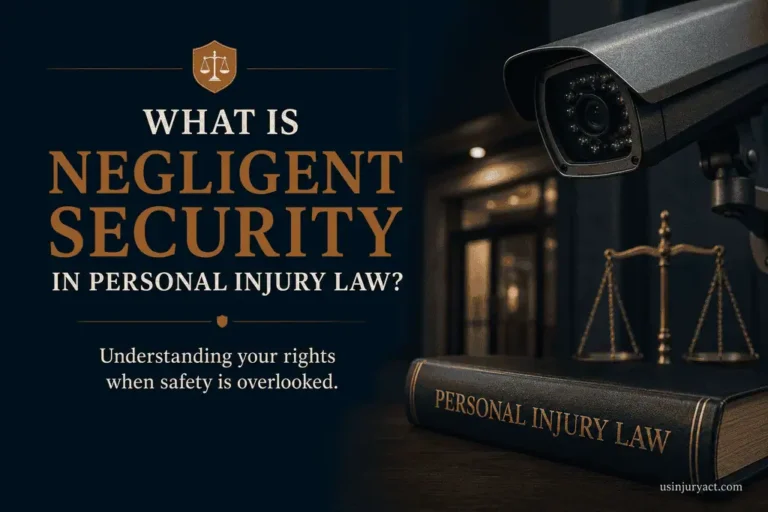
Most people assume that crimes happen because criminals make choices, and that no one else bears legal responsibility for those choices. But the law does not always agree.
When a business, property owner, or landlord fails to take reasonable precautions to protect people on their premises, and someone is injured or killed as a result of a foreseeable criminal act, the victim may have a viable negligent security claim.
Negligent security in personal injury law holds property owners accountable for creating or maintaining dangerous conditions that allow crime to flourish. If you were attacked, robbed, assaulted, or sexually assaulted on someone else’s property, negligent security may be the legal theory that entitles you to compensation.
Defining Negligent Security in Legal Terms
Negligent security is a subspecialty of premises liability law. It applies when a property owner’s failure to implement adequate security measures foreseeably contributes to a criminal attack on a lawful visitor.
The legal theory is grounded in the principle that property owners owe visitors a duty of reasonable care, and that duty includes taking steps to protect against foreseeable criminal acts when the circumstances warrant it.
It is important to note that the criminal who committed the act remains personally liable. Negligent security does not excuse the attacker, it simply creates an additional avenue of civil liability for the property owner whose negligence allowed the crime to occur.
The Legal Basis: Premises Liability and Foreseeability
Negligent security claims rest on the same four elements of negligence that apply to all personal injury cases: duty, breach, causation, and damages. The unique challenge in negligent security cases is proving that the criminal act was foreseeable.
Courts do not expect property owners to prevent every possible crime. What the law requires is that owners take reasonable security measures when they know or should know that criminal activity is a realistic risk on or near their property.
Foreseeability is typically proven through evidence of prior similar incidents at the same location, crime statistics for the surrounding area, and any complaints or warnings the property owner received about security concerns.
The Role of Prior Crimes in Proving Foreseeability
Perhaps the most powerful evidence in a negligent security case is a history of prior criminal incidents at the same property.
If a parking garage has experienced multiple robberies in the past year and the owner took no additional security measures, a new victim of robbery in that garage has strong grounds to argue that the attack was foreseeable.
Courts in states like Florida, Georgia, and Texas have extensively analyzed this issue. In some jurisdictions, prior crimes on the specific property are required.
In others, courts look at the broader neighborhood crime environment. Your attorney will investigate local police reports, 911 call logs, incident reports, and any prior complaints made to management.
Common Locations Where Negligent Security Claims Arise
Negligent security claims can arise on virtually any type of property where people gather. However, some settings see these cases far more frequently than others.
Hotels and motels are frequent defendants in negligent security cases.
A hotel guest who is attacked in a poorly lit parking lot, robbed in a stairwell with a broken door lock, or assaulted in a room with a malfunctioning deadbolt may have a viable claim against the hotel owner.
Hotels have a particularly high duty of care because guests pay for the right to safe accommodations.
Apartment complexes and residential properties are another major category.
Tenants who are attacked in common areas, hallways, laundry rooms, or parking lots often bring negligent security claims against their landlords, especially when broken lights, malfunctioning gate access, or absent security personnel contributed to the attack.
Shopping malls and retail centers have been the subject of landmark negligent security verdicts.
When a shopper is carjacked in an inadequately patrolled parking lot or attacked inside a store, the property owner’s failure to hire security guards, install cameras, or improve lighting can form the basis of a lawsuit.
Nightclubs and bars
Nightclub and bars carry an elevated duty of care because alcohol and late-night hours create predictable risk factors for violent incidents.
When bar staff or bouncers fail to control escalating confrontations or when management ignores known dangers, attacks that result can lead to significant civil liability.
Schools, hospitals, apartment parking structures, and transit facilities have all been the subject of successful negligent security litigation.
What Constitutes Inadequate Security?
The specific security measures a property owner must provide depend on the nature of the property and the foreseeable risks associated with it. However, courts and legal experts have identified several categories of deficiency that frequently support negligent security claims.
Inadequate lighting
Inadequate lighting is one of the most common deficiencies. Poorly lit parking lots, hallways, stairwells, and entrances create conditions in which attackers can act without detection. Expert testimony about industry lighting standards is often used to establish that the property owner fell short of what was reasonably required.
Broken or absent locks, gates, and access controls
An apartment building whose key card access system has been broken for weeks, or a hotel whose exterior door lock is defective, creates a foreseeable path for criminal intrusion. Maintenance records, work orders, and complaint logs are critical evidence.
Insufficient security personnel
A large nightclub or apartment complex in a high-crime area may require trained security guards to meet the standard of reasonable care. If the owner cut costs by eliminating security staff, that decision can be directly linked to the attack that followed.
Non-functional surveillance cameras, absent emergency call stations, and failure to train staff on security protocols round out the most commonly cited deficiencies.
For Instance: The Hotel Assault
Consider a woman who checks into a budget hotel in a city she is visiting for work. The hotel is located in an area with a documented history of criminal activity. She parks in the hotel’s unlit rear parking lot. The exterior door near the lot has had a broken lock for three weeks, and management has not repaired it. When she walks toward the elevator, she is attacked and robbed.
Her attorney subpoenas maintenance records showing the lock was reported broken 21 days before the incident. Police records reveal five prior incidents in that parking lot over the past year.
The hotel failed to hire overnight security despite these incidents and took no action to repair the access door. In cases like this, the attack was foreseeable, the hotel’s security failures constituted a breach of its duty of care, and those failures were a proximate cause of the assault.
Another Instance: Apartment Complex Shooting
A tenant is shot in the parking lot of his apartment complex after someone broke through a rusted, unsecured pedestrian gate. He survives but sustains permanent injuries. The complex is in a neighborhood with a high rate of violent crime, meanwhle management had received multiple written complaints from tenants about the broken gate and the absence of any security lighting.
His personal injury attorney files suit against the property management company, arguing that the foreseeable criminal intrusion was enabled by the complex’s failure to maintain basic security infrastructure.
Depositions of the property manager reveal that the gate had been broken for over two months. An expert in security consulting testifies that industry standards for residential properties in high-crime areas require functional perimeter fencing, adequate lighting, and periodic security patrols.
Damages Available in Negligent Security Cases
Victims of negligent security can pursue the same categories of damages available in other personal injury claims.
Economic damages include medical bills, hospitalization, rehabilitation, psychiatric care, and lost wages.
Non-economic damages cover the profound emotional impact of violent victimization, including post-traumatic stress disorder, chronic anxiety, depression, and loss of enjoyment of life.
In cases involving egregious indifference to known dangers, courts may award punitive damages to punish the property owner and deter similar neglect.
Because the injuries in negligent security cases often include severe physical trauma, sexual assault, or the death of a loved one, damages awards in these cases can be substantial.
Wrongful death actions arising from negligent security failures are among the most significant personal injury claims litigated in American courts.
How to Build a Strong Negligent Security Case
Proving negligent security requires aggressive investigation and the right expert witnesses.
Your attorney will pursue incident reports, police records, surveillance footage, and maintenance logs.
A security expert will evaluate the property against industry standards and offer a professional opinion on the adequacy of the measures in place.
Medical experts will establish the connection between the attack and your documented injuries.
Time is critical in these cases because evidence disappears and surveillance footage gets overwritten so if you or a loved one was the victim of a criminal attack on someone else’s property, you should contact a personal injury attorney as quickly as possible to preserve your right to compensation.
In a Nutshell
Negligent security is a recognition that property owners who profit from the presence of guests, tenants, customers, and visitors must take reasonable steps to protect them from foreseeable criminal harm. When they fail to do so, and someone is hurt, the law holds them accountable.
If you were injured in an attack that occurred on poorly secured property, you have legal rights that deserve to be fully explored and vigorously pursued.