Being injured as a passenger in an Uber is a disorienting experience, You requested a ride, fastened your seatbelt, and trusted that you would arrive safely. Then something went wrong, and now you are facing medical bills, missed work, and a company with billions of dollars in resources standing between you and the compensation you deserve.
So can you sue Uber if you were injured as a passenger? The short answer is yes, but the path is more complicated than suing a typical employer for its employee’s negligence.
This article explains Uber’s unique legal structure, how insurance coverage works at different stages of a ride, what legal theories support your claim, and the real-world obstacles you will face.
Having the knowledge of these issues before you speak with a lawyer will put you in a far stronger position.
The Independent Contractor Classification: Uber’s Primary Legal Shield
The central challenge in any lawsuit against Uber is the company’s classification of its drivers as independent contractors rather than employees.
Under traditional respondeat superior doctrine, an employer is vicariously liable for the negligent acts of its employees committed in the course of their employment. If Uber drivers were employees, Uber’s liability exposure would be vast and nearly automatic.
Uber has consistently and aggressively defended the independent contractor classification in courts across the country. The argument is that because Uber merely provides a technology platform that connects riders with drivers, it is not in the business of transportation and therefore cannot be held responsible for driver negligence under vicarious liability theory.
Courts have reached conflicting conclusions. Some jurisdictions have found sufficient control by Uber over the working conditions, route selection, pricing, and performance standards of its drivers to support an employment-like relationship.
Others have deferred to the contractual designation. This jurisdictional split means the viability of a direct negligence claim against Uber as a corporate entity varies significantly depending on where your injury occurred.
Uber’s Insurance Framework: Three Distinct Coverage Periods
Regardless of the employment classification debate, Uber maintains a structured insurance program that provides coverage to injured passengers. The level of coverage depends on the phase of the ride at the time of the accident.
This framework has been significantly shaped by state-level transportation network company statutes passed in the wake of rideshare expansion.
Period 1: App Open, No Ride Accepted
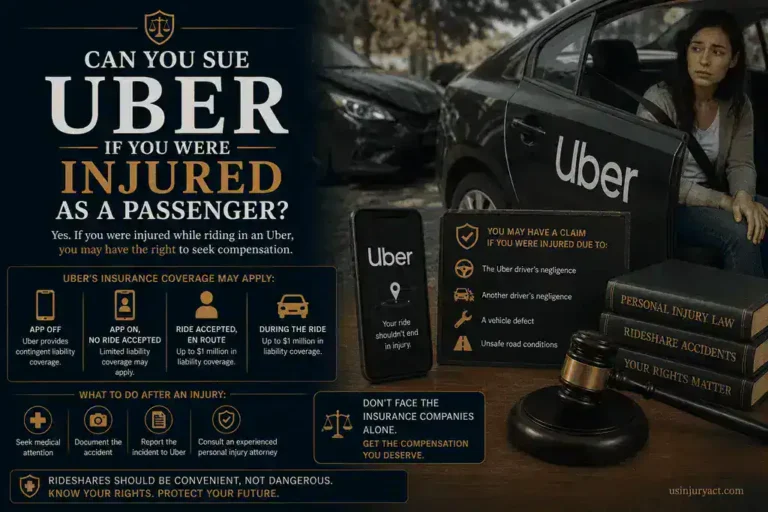
When a driver has the Uber app open and is waiting for a ride request but has not yet accepted a trip, Uber provides contingent liability coverage with limits of $50,000 per person per accident, $100,000 per accident, and $25,000 in property damage.
This coverage only applies if the driver’s personal auto insurer denies the claim, which they often do because most personal policies exclude commercial activity.
Period 2: Ride Accepted, En Route to Pick Up
Once a driver accepts a ride request and begins driving to pick you up, Uber’s primary coverage steps up dramatically. Uber provides up to $1 million in third-party liability coverage, plus uninsured and underinsured motorist coverage and contingent comprehensive and collision coverage.
Although you are not yet in the car during this period, this phase is important because accidents can occur during pick-up.
Period 3: Passenger In the Vehicle
From the moment you enter the vehicle until you exit at your destination, Uber provides its fullest coverage: $1 million in liability coverage per occurrence, plus uninsured motorist and underinsured motorist coverage.
This is the phase most relevant to passenger injury claims. If you were hurt while riding in an Uber, this $1 million policy is the primary resource for your recovery.
It is important to understand that even this robust coverage has limits. In catastrophic injury cases involving spinal cord injuries, traumatic brain injuries, or wrongful death, $1 million may not cover the full extent of damages. In those cases, attorneys will explore every avenue to reach additional coverage sources.
Direct Negligence Theories Against Uber the Company
Even if Uber successfully argues that its driver is not an employee, you may still have direct negligence claims against Uber as a corporate entity. These theories do not depend on the employment classification and can be powerful tools in the right case.
Negligent Hiring and Retention
Uber has a legal duty to take reasonable steps to screen drivers before allowing them on the platform and to remove drivers who demonstrate dangerous behavior. If Uber permitted a driver with a history of DUI convictions, reckless driving charges, or prior passenger complaints to continue operating, and that driver subsequently injures you, Uber may face direct liability under negligent hiring and retention theory.
This theory has been successfully raised in multiple Uber-related lawsuits. In 2019, a CNN investigation revealed that thousands of Uber drivers had been accused of serious misconduct, including sexual assault.
Cases arising from those incidents often named Uber directly, alleging the company’s background screening process was inadequate and that it retained drivers despite receiving warning signals.
Negligent Supervision and Control
Courts in some jurisdictions have found that Uber exercises enough control over the operational details of its drivers to create a duty of supervision. When Uber sets minimum vehicle standards, mandates GPS route compliance, and requires drivers to maintain customer ratings or face deactivation, it is exercising control consistent with an employer-like relationship.
If Uber fails to act on red flags and a passenger is harmed, negligent supervision claims can follow.
Product Liability: The App as a Defective Product
An emerging theory in rideshare litigation involves the Uber app itself as a product. If the app design encourages distracted driving by requiring drivers to check the app for navigation instructions or new ride requests while en route, and if that distraction contributes to an accident, the company could face product liability claims.
While this theory is less established than traditional negligence theories, it is being developed in ongoing litigation.
When the Other Driver Caused the Accident
Many Uber passenger injury cases involve accidents caused not by the Uber driver but by a third-party driver. If another vehicle ran a red light and struck your Uber, you have a direct negligence claim against that driver. However, if that driver is uninsured or underinsured, Uber’s uninsured and underinsured motorist coverage, active during Period 3, can fill the gap.
In multi-vehicle accident cases, your attorney will identify every potentially liable party and every applicable insurance policy. Leaving money on the table because you only pursued one source of recovery is a common and costly mistake.
Uber Passenger Injury Cases Example
Let’s say a woman in Los Angeles is riding in an Uber when the driver runs a red light and collides with a city bus. She sustains a herniated disc requiring surgery and misses three months of work. The Uber app was confirmed to be active during the trip, placing the ride squarely in Period 3.
Her attorney can file a claim against Uber’s $1 million liability policy, compiles all medical records and wage loss documentation, and retains a spine surgeon as an expert witness, and in most cases, the case will resolve before trial for likely a seven figure amount.
Another example is a college student in Atlanta sexually assaulted by her Uber driver during a late-night ride. Investigation reveals the driver had two prior criminal complaints on his record from before he was approved as an Uber driver and that Uber’s background check had failed to capture the relevant information.
The student’s attorney files suit against both the driver individually and Uber directly under negligent hiring theory. The case proceeds to discovery before settling.
Arbitration Clauses As A Hidden Obstacle in Your User Agreement
When you created your Uber account and agreed to the terms of service, you almost certainly agreed to a mandatory arbitration clause. This provision requires that disputes with Uber be resolved through private arbitration rather than in a public courtroom with a jury.
Arbitration is generally less favorable to plaintiffs, offers no right to appeal, and keeps outcomes confidential.
However, courts have shown growing skepticism toward these clauses, particularly in cases involving serious physical injury. Some courts have refused to enforce arbitration agreements in personal injury contexts, and class action suits have successfully challenged the scope and fairness of mandatory arbitration provisions.
Your attorney can evaluate the enforceability of this clause in your specific jurisdiction.
Steps to Take Immediately After Being Injured in an Uber
- Call 911 and ensure a police report is filed at the scene
- Seek medical attention immediately, even if your injuries seem minor at first
- Screenshot the Uber app to preserve proof that your trip was active at the time of the accident
- Photograph the scene, all vehicles involved, and any visible injuries
- Collect contact information for all drivers involved and any witnesses
- Report the incident through the Uber app using the safety incident reporting feature
- Do not speak to any insurance adjusters, including Uber’s, before consulting a personal injury attorney
Conclusion: Can You Sue Uber If You Were Injured as a Passenger
Yes, you can absolutely sue Uber if you were injured as a passenger, but the legal structure is not as straightforward as a car accident case. Between Uber’s independent contractor defense, its tiered insurance structure, potential direct negligence theories, and arbitration clauses, navigating this litigation requires experience and strategic thinking.
Hire a personal injury attorney who has handled rideshare injury cases specifically. The combination of insurance coverage and multiple potential liability theories makes Uber passenger injury cases highly recoverable when pursued correctly.