Someone who recently got involved in a car accident may be thinking about no-fault auto insurance and wondering who pays the medical bills regardless of who caused the crash.
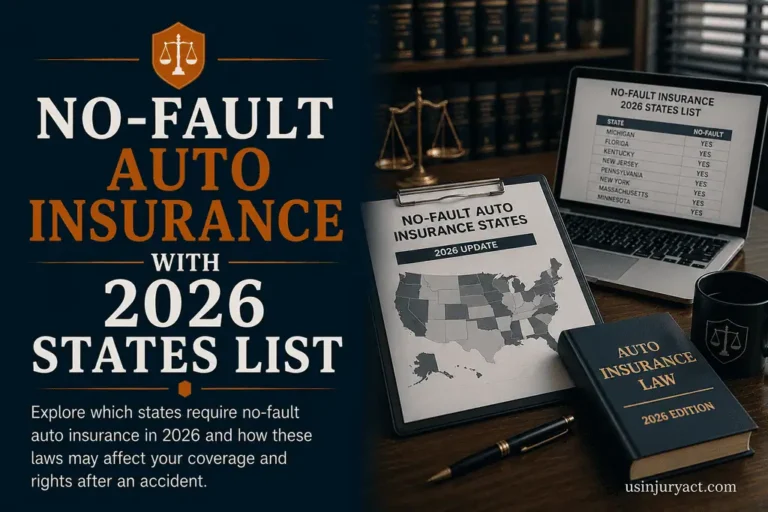
In 2026, a total of twelve states plus the District of Columbia and Puerto Rico operate under some form of mandatory no-fault auto insurance law. If you live in one of these states, the rules that govern what you can recover after an accident are fundamentally different from the rest of the country.
In this post, we covers every no-fault state in the United States, what the law requires, what you can and cannot sue for, and how the system has evolved heading into 2026.
What No-Fault Auto Insurance Actually Means
No-fault auto insurance is a system in which each driver’s own insurance company pays for their medical bills and certain economic losses after a car accident, regardless of who was at fault.
In a traditional tort state, if another driver causes the accident, you sue them or file a claim against their liability policy. In a no-fault state, you first go to your own insurer under your Personal Injury Protection, commonly called PIP coverage.
The core policy goal of no-fault insurance is to speed up compensation for accident victims and reduce the volume of litigation over minor crashes. In theory, a person injured in a fender-bender should not have to wait years to recover their medical costs while a liability lawsuit works its way through the courts.
No-fault makes your insurer responsible for those costs immediately.
However, no-fault systems almost always come with a limitation on your right to sue. Called the tort threshold, this restriction means you generally cannot file a personal injury lawsuit against the at-fault driver unless your injuries meet a defined standard of severity. This is where no-fault law becomes most consequential for accident victims.
The Two Types of Tort Thresholds
States that restrict lawsuits in no-fault systems use one of two threshold types.
- The verbal threshold describes injuries using qualitative language such as serious injury, permanent impairment, or significant disfigurement.
- The monetary threshold bars lawsuits unless your medical expenses exceed a certain dollar amount.
New York uses a verbal threshold requiring a serious injury as defined by statute.
Michigan, after its 2019 reform, created a modified verbal threshold with specific injury tiers.
Florida uses a monetary threshold combined with a serious injury standard.
Therefore being aware of your state’s specific threshold is essential to knowing your full legal rights after any accident.
Complete 2026 No-Fault Auto Insurance States List
The following states maintained mandatory no-fault auto insurance laws as of 2026. Each entry notes the required PIP minimums and the type of tort threshold in place.
Florida
Florida requires $10,000 in PIP coverage for all registered vehicle owners. PIP pays 80 percent of medical bills and 60 percent of lost wages up to the $10,000 limit. Florida uses a monetary threshold, which means you cannot sue the at-fault driver unless your medical bills exceed $10,000 or you suffered a permanent injury, significant and permanent scarring, or significant and permanent loss of an important bodily function.
Florida has one of the most litigated no-fault systems in the country. The Florida legislature has repeatedly examined PIP reform, and as of 2026, the PIP requirement remains in effect after prior repeal attempts failed to achieve full legislative passage.
Michigan
Michigan’s no-fault law was substantially reformed by Public Act 21 of 2019 and its revisions remain operative through 2026. Michigan offers tiered PIP election options including unlimited medical coverage, $500,000, $250,000, and lower limits for Medicare and Medicaid recipients.
Michigan’s tort threshold is a verbal standard requiring that injuries result in death, serious impairment of body function, or permanent serious disfigurement before a lawsuit against the at-fault driver is allowed.
Michigan also imposes a fee schedule limiting what medical providers can charge for treatment of auto accident injuries, a provision that has dramatically affected care access in some communities.
New York
New York requires a minimum of $50,000 in PIP coverage, making it one of the more generous mandatory minimums in the country.
New York’s verbal threshold requires a serious injury, which the Insurance Law defines to include death, dismemberment, significant disfigurement, fracture, loss of a fetus, permanent loss of use of a body organ or member, permanent consequential limitation of use of a body organ or member, significant limitation of use of a body function or system, or a medically determined injury preventing the insured from performing substantially all customary daily activities for 90 out of 180 days following the accident.
The definition of serious injury in New York has generated decades of case law.
New Jersey
New Jersey operates a choice no-fault system. Policyholders can select either a standard policy with full tort rights or a basic policy with a verbal threshold limiting the right to sue.
PIP minimums under the standard policy begin at $15,000. New Jersey’s verbal threshold uses the language of a permanent injury characterized by objective clinical evidence or a significant body part limitation. New Jersey also allows policyholders to purchase the unlimited right to sue as an add-on, making it one of the more flexible no-fault systems in the country.
Pennsylvania
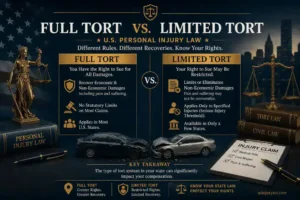
Pennsylvania, like New Jersey, operates a choice system. Drivers choose between limited tort and full tort coverage when purchasing their policy.
Limited tort policyholders waive the right to sue for pain and suffering unless they suffer a serious injury as defined by state law while full tort policyholders retain full legal rights.
PIP minimums in Pennsylvania are set at $5,000. The limited tort election is a default in many policies, and many Pennsylvania drivers do not fully understand the consequence of that election until they are already injured.
Hawaii
Hawaii requires $10,000 in PIP coverage. The tort threshold is a monetary standard barring suit unless medical expenses exceed $5,000, unless the injury involves a fracture, serious permanent disfigurement, or is otherwise a serious injury. Hawaii’s no-fault statute has remained relatively stable in recent years.
Kentucky
Kentucky is another choice state. Residents can opt out of the no-fault system when purchasing their policy. Those who remain in the no-fault system must carry a minimum of $10,000 in basic reparations benefits.
Kentucky’s monetary tort threshold prevents lawsuits unless medical expenses exceed $1,000 or the injury involves a fracture, permanent injury, disfigurement, loss of a body member, or death.
Massachusetts
Massachusetts requires $8,000 in PIP coverage. The monetary tort threshold bars lawsuits unless medical bills exceed $2,000 or the injury involves death, fracture, loss of hearing or sight, loss of a body member, or permanent and serious disfigurement.
Massachusetts drivers are strongly encouraged to purchase medical payments coverage in addition to PIP to supplement the relatively low minimum.
Minnesota
Minnesota requires $40,000 in basic economic loss coverage ($20,000 for medical expenses and $20,000 for income loss).
Minnesota’s verbal threshold requires that injuries result in death, permanent disfigurement, disability for 60 or more days, or medical bills exceeding $4,000 before a tort lawsuit is permitted. Minnesota is notable for having one of the higher economic loss coverage minimums in the country.
North Dakota
North Dakota requires a minimum of $30,000 in PIP coverage. The verbal threshold in North Dakota requires serious injury resulting in death, serious and permanent disfigurement, or disability for 60 days or more.
North Dakota’s no-fault system is straightforward and has seen little significant legislative change in recent years.
Utah
Utah requires $3,000 in PIP coverage, one of the lower mandatory minimums in the no-fault system. Utah’s monetary tort threshold bars lawsuits unless medical expenses exceed $3,000.
Utah also allows lawsuits when injury involves death, dismemberment, permanent disability, or permanent disfigurement. Utah has explored increasing its PIP minimums in response to rising medical costs.
Kansas
Kansas requires $4,500 in personal injury protection for medical benefits, $900 per month for disability and loss of income, $25 per day for rehabilitation, and $2,000 for funeral expenses.
Kansas uses a monetary and verbal combined threshold. Lawsuits are barred unless medical expenses exceed $2,000 or the injury results in death, fracture, permanent injury, or permanent disfigurement.
District of Columbia
The District of Columbia is a no-fault state offering optional personal injury protection The D.C. tort threshold is a verbal standard.
Puerto Rico
Puerto Rico operates a government-administered no-fault insurance system through the Compulsory Liability Insurance Fund, known by its Spanish acronym ACAA. All drivers pay into this fund through their vehicle registration fees.
The fund covers medical expenses and death benefits for all accident victims regardless of fault. Puerto Rico does not use private PIP policies. Third-party tort claims are available for damages beyond what the government fund provides.
States That Considered No-Fault Reform in 2025 and 2026
Florida’s legislature revisited the question of replacing PIP with mandatory bodily injury liability coverage in 2025, continuing a debate that has been ongoing since 2021.
As of the time of publication, Florida retained its PIP system. Michigan continued to face litigation over the implementation of its 2019 reform law, particularly regarding the fee schedule for medical treatment and the administration of attendant care benefits for catastrophically injured accident victims.
Several states outside the traditional no-fault tier, including Oregon and Colorado, have seen advocacy groups propose optional no-fault systems, though no new state adopted mandatory no-fault legislation through early 2026.
The no-fault auto insurance debate in those states largely centers on whether the system reduces litigation or simply shifts costs to accident victims.
How PIP Coverage Works After an Accident
After an accident in a no-fault state, you open a PIP claim with your own insurance company, you do not need to prove the other driver was at fault to receive PIP benefits. Your insurer is obligated to begin paying your covered medical expenses promptly.
PIP coverage typically pays for hospital bills, doctor’s visits, surgery, rehabilitation, lost wages at a defined percentage, and in some states, household services you can no longer perform. It does not typically cover pain and suffering, which remains recoverable only through a tort lawsuit if you meet the threshold.
Important: PIP benefits are often coordinated with your health insurance. In some states, your health insurer pays first and PIP acts as a secondary payor. In others, PIP pays first.
Your Right to Sue in No-Fault States
Meeting the tort threshold in your state does not guarantee a full recovery in a lawsuit. It simply unlocks your right to file one. Once you qualify to sue, you can pursue pain and suffering damages, full lost wages, future medical costs, and other non-economic losses from the at-fault driver’s liability insurance policy.
For accident victims with serious injuries, the combination of PIP benefits and a successful third-party tort claim often provides the most complete recovery.
Your attorney will advise you on how to structure the claim to maximize recovery from both avenues.