Being hit by an uninsured driver is one of the most frustrating experiences a car accident victim can face. You did everything right. You drove safely, followed the rules, and still ended up injured and facing medical bills because someone else failed to carry the legally required auto insurance.
The bad news is that this situation is far more common than most people realize. The good news is that you are not out of options. Knowing exactly what to do after a crash with an uninsured driver can be the difference between recovering your losses fully and bearing them alone.
This post will walk you through every step you need to take, every legal avenue available to you, and the strategies that experienced personal injury attorneys use to recover compensation even when the at-fault driver has no insurance.
How Common Is Driving Without Insurance in the United States?
According to data published by the Insurance Research Council, roughly one in eight drivers on American roads is uninsured. In some states, that number climbs even higher.
California, for example, has historically had uninsured driver rates that exceed the national average, with some estimates placing the figure close to one in six drivers.
When you share the road with millions of people daily, the statistical reality is sobering. A driver can cause a serious crash, injure you severely, and carry absolutely zero liability coverage.
At that point, your own preparation and your legal strategy become the foundation of your recovery.
Your First Priority: Safety and Evidence at the Scene
Immediately after a crash, your first obligation is to your own safety. Move out of traffic if possible, call 911, and request both police and emergency medical services.
Even if you believe your injuries are minor, always accept a medical evaluation at the scene. Adrenaline masks pain. Internal injuries, traumatic brain injuries, and soft tissue damage are all conditions that may not present obvious symptoms for hours or even days after impact.
Once you are safe, begin gathering evidence. This is especially important when the other driver appears to be uninsured, because that evidence becomes the backbone of any future legal claim.
Evidence You Must Collect at the Scene
- Photograph every angle of both vehicles, including close-ups of damage and wide shots showing the accident location
- Capture the other driver’s license plate, driver’s license, and any insurance information they provide, even if it turns out to be expired or invalid
- Get the names and contact information of every witness present
- Photograph road conditions, traffic signals, skid marks, and any physical details that establish how the crash occurred
- Request the responding officer’s name and badge number, and ask how to obtain the official police report
The police report is especially valuable in an uninsured driver case. When the officer documents that the other driver was uninsured, this creates an official record that supports your subsequent insurance claims and any lawsuit you may file.
What to Do When the Other Driver Admits Having No Insurance
Some drivers will openly tell you at the scene that they have no insurance. Others will hand you a card that turns out to be lapsed or cancelled. Either way, your response is the same: remain calm, do not negotiate or accept any informal payment agreements on the spot, and make note of everything they say.
Do not agree to “settle this privately.” An informal handshake deal at a crash scene carries no legal weight.
The other driver could promise to pay you and then vanish, leaving you with no enforceable remedy and a clock that has already started running on your legal deadlines.
Never accept an informal payment offer from an uninsured driver at the crash scene.
Verbal agreements are nearly impossible to enforce, and you almost certainly do not yet know the full extent of your injuries or property damage.
Uninsured Motorist Coverage: Your Single Most Important Protection
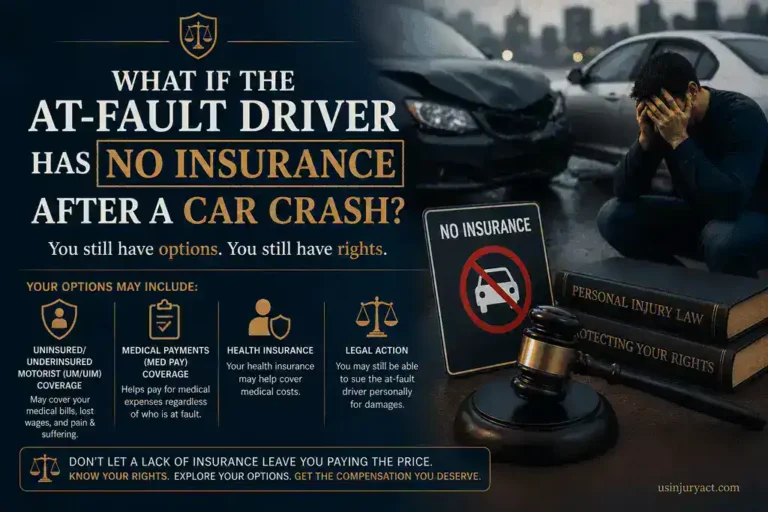
If you have uninsured motorist (UM) coverage on your own auto insurance policy, this is typically the first and most powerful tool available to you after a crash with an uninsured driver.
UM coverage is designed precisely for this scenario: when the at-fault party cannot pay, your own insurer steps in and compensates you as if they were the responsible party’s insurer.
In many states, including California, insurers are required by law to offer uninsured motorist coverage when they sell you a policy. If you declined it, that declination should have been in writing.
If you accepted it, your policy should cover your medical expenses, lost wages, and pain and suffering up to your policy limits.
Underinsured Motorist Coverage (UIM) Works Differently
Underinsured motorist (UIM) coverage addresses a slightly different but equally common scenario: when the at-fault driver has some insurance, but their policy limits are not enough to cover your full damages.
For example, if the at-fault driver carries only $15,000 in liability coverage but your medical bills alone exceed $80,000, your UIM coverage can make up the gap up to your policy limits.
Both UM and UIM claims require prompt notification to your insurer. Check your policy for reporting deadlines as failing to report within the required window can give your insurer grounds to deny your claim, regardless of fault.
Filing a Lawsuit Directly Against the Uninsured Driver
You have every legal right to sue an uninsured at-fault driver directly in civil court. The challenge, and it is a real one, is collecting on a judgment if the driver has no assets.
Personal injury attorneys call this being “judgment proof.” A court can award you $500,000 in damages, but if the defendant has no property, no savings, and no garnishable income, that judgment may be worth very little in practical terms.
That said, filing suit is still the right strategy in several situations. First, if the driver owns real property, has a steady income, or has other assets, a judgment can be enforced through wage garnishment, bank levies, or liens on real estate.
Second, in some cases, filing suit creates pressure that results in settlement. Third, a judgment lasts for years in most states and can be renewed, meaning that if the defendant’s financial situation improves in the future, you can still collect.
A Real-World Scenario: When Suing the Uninsured Driver Paid Off
Consider the case of a construction worker who was struck by an uninsured driver running a red light. The driver had no insurance, drove an old vehicle with no equity, and had no savings.
His attorney filed suit anyway, partly because the driver was employed with a stable income. The court awarded the injured worker a judgment, and his attorney immediately filed for wage garnishment.
Over the following years, the worker collected the full judgment through regular deductions from the defendant’s paycheck. The process required patience, but it delivered full compensation.
The Role of MedPay Coverage After a Crash With an Uninsured Driver
Medical payments coverage, commonly called MedPay, is another first-party coverage option that can help you pay medical bills after a crash regardless of fault.
Unlike UM coverage, MedPay is typically a smaller coverage limit and does not compensate for lost wages or pain and suffering. However, it pays quickly, does not require a fault determination, and can be used to cover immediate treatment costs while your UM claim or lawsuit is pending.
Some drivers have MedPay without fully realizing it. Check your declarations page carefully or call your agent to confirm what coverages are active on your policy.
When a Third Party May Be Liable
In some crashes involving uninsured drivers, a third party shares legal responsibility. Identifying that third party can open an entirely new avenue for compensation.
- A bar or restaurant that over-served an intoxicated uninsured driver may be liable under dram shop laws
- An employer whose employee was driving without insurance during work hours may be responsible under the doctrine of respondeat superior
- A vehicle owner who knowingly loaned their car to an uninsured or unlicensed driver may carry liability
- A government entity may share fault if a dangerous road condition contributed to the crash
Identifying third-party liability requires a thorough investigation that most accident victims are not equipped to conduct on their own.
A personal injury attorney with accident reconstruction resources and investigative staff can uncover liability that initially appears invisible.
Practical Steps to Take in the Days Following the Crash
The period immediately after a crash with an uninsured driver is critical. Here is what you need to prioritize.
- Seek comprehensive medical care: See a doctor or specialist even if the ER cleared you. Emergency rooms triage life-threatening conditions but may not diagnose all injuries relevant to a personal injury claim.
- Notify your insurer promptly: Contact your own insurance company to report the crash and inquire about your UM and MedPay coverage. Be factual and brief. Do not speculate or give recorded statements without first speaking to an attorney.
- Consult a personal injury attorney: Most personal injury attorneys work on contingency, meaning they charge no fee unless they recover compensation for you. An initial consultation costs you nothing and can reveal legal options you did not know existed.
- Document your damages meticulously: Save every medical bill, prescription receipt, and explanation of benefits. Keep a journal documenting your pain levels, physical limitations, and the impact on your daily life. This documentation directly supports your claim for non-economic damages.
What Happens If You Have No UM Coverage and No Assets to Pursue?
If you declined uninsured motorist coverage, have no MedPay, and the at-fault driver is judgment proof, your options narrow significantly but do not disappear entirely.
Your attorney can still investigate the crash for any third-party liability. You may also qualify for health insurance coverage through employer benefits, government programs, or the Affordable Care Act marketplace to cover your medical costs.
Beyond that, the experience underscores a critical lesson: uninsured motorist coverage is one of the most important protections you can carry on your own policy. In states with high rates of uninsured drivers, it is not optional in any practical sense of the word.
In Summary
A crash with an uninsured driver is a serious legal situation, but it is not a dead end.
Uninsured motorist coverage through your own policy is often the fastest and most reliable path to compensation.
Lawsuits against uninsured drivers can succeed when those drivers have attachable assets or income.
Third-party liability investigations may reveal additional responsible parties. And throughout this process, working with a qualified personal injury attorney maximizes your chance of a full recovery.
Do not assume that because the other driver has no insurance, you have no recourse.
The legal system provides multiple paths forward, and knowing how to navigate them makes all the difference.