
Thousands of children across the United States are seriously injured or killed after wandering onto private property and encountering hazardous conditions every year. In many of these cases, the law holds property owners accountable, not because they invited the child, but because the hazardous condition itself was an invitation. This is the core principle behind the attractive nuisance doctrine.
The attractive nuisance doctrine is one of the most important and humanizing principles in American premises liability law. It recognizes a fundamental truth: children do not reason the way adults do. They are drawn by curiosity, they do not fully understand danger, and they cannot be expected to stay away from a tempting hazard simply because they are technically trespassing.
The law therefore imposes a special duty on property owners to protect children from foreseeable harm, even when those children have no legal right to be on the property.
This guide is designed to be the most comprehensive legal resource on the attractive nuisance doctrine available in the United States for anyone including but not limited to property owner seeking to understand your legal obligations, a parent whose child has been injured, or an attorney building or defending a claim, this guide will walk you through every dimension of this doctrine, from its historical roots to its modern application in courtrooms across the country.
You will learn the legal definition of the attractive nuisance doctrine, the specific elements that must be proven, how courts across different states interpret and apply the rule, what defenses are available to property owners, and how litigation strategy shapes outcomes in real cases.
What Is the Attractive Nuisance Doctrine
The attractive nuisance doctrine is a legal rule within premises liability law that holds property owners liable for injuries to trespassing children caused by dangerous conditions or objects on their property, provided those conditions are likely to attract children and the owners knew or should have known of the risk.
Under general premises liability principles, a landowner owes very little duty of care to trespassers. An adult who enters property without permission generally cannot sue the owner if they are injured there. The attractive nuisance doctrine carves out a major exception to this rule when the injured trespasser is a child.
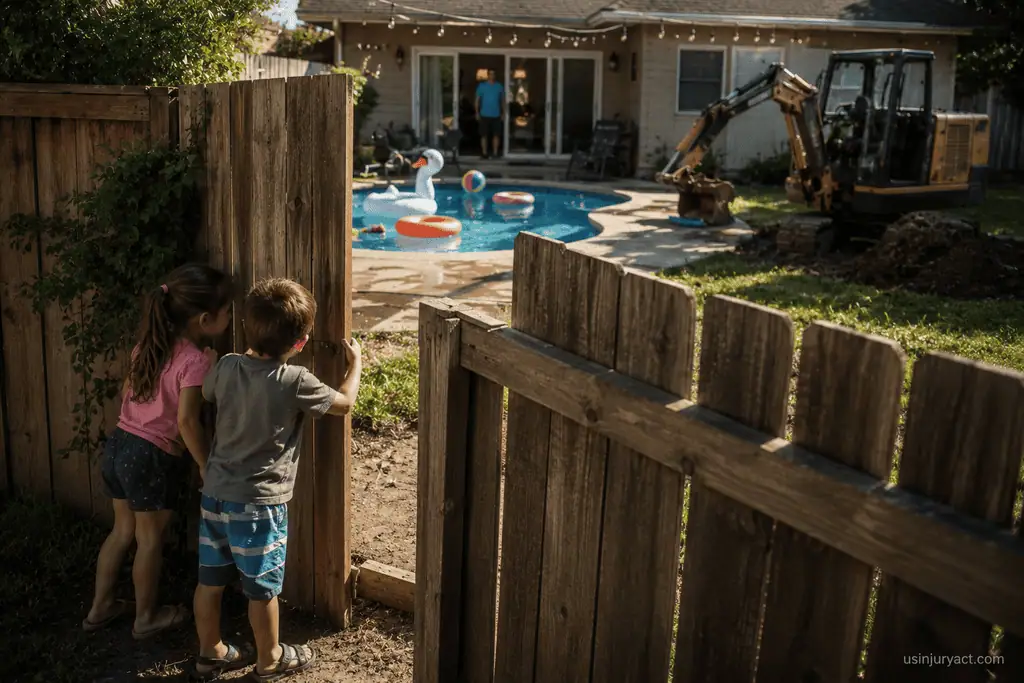
The logic is straightforward. A child lacks the cognitive and developmental capacity to recognize and appreciate hazards that an adult would identify immediately. A backyard swimming pool, an idling piece of construction machinery, or an abandoned building may present obvious danger to a reasonable adult.
To a curious five-year-old for instance, those same conditions represent an opportunity for play and exploration.
The attractive nuisance doctrine does not require that the property owner intended harm. It only requires that a foreseeable hazard existed, that children were likely to encounter it, and that the owner failed to take reasonable steps to prevent access or eliminate the danger.
This doctrine sits within the broader body of premises liability law, which governs the obligations landowners have to people who enter their property. Within that framework, it serves as a protective rule specifically designed with the vulnerability of children in mind.
Historical Background and Legal Foundation
Origins of the Doctrine
The attractive nuisance doctrine has its roots in 19th century American common law. One of the earliest and most frequently cited cases establishing the principle is Sioux City and Pacific Railroad Co. v. Stout, decided by the United States Supreme Court in 1873.
In that case, a six-year-old boy was injured while playing on a railroad turntable left unsecured on the defendant’s property. The Court held that the railroad could be found negligent for leaving the dangerous machinery accessible to children who were foreseeably likely to play with it.
This became known as the turntable doctrine, named after the type of machinery involved in the early cases that shaped it. Over the following decades, courts across the country applied this principle to a growing range of hazards, gradually expanding it from railroad equipment to swimming pools, excavations, electrical transformers, and much more.
The Restatement of Torts and Modern Formulation
The legal foundation of the modern attractive nuisance doctrine is most clearly articulated in Section 339 of the Restatement (Second) of Torts, which was adopted by the American Law Institute and has been widely embraced by courts throughout the United States.
This provision sets out the five conditions that must be met for a property owner to be held liable for injuries to trespassing children.
The Restatement formulation moved the doctrine away from the older requirement that the hazard itself had to literally attract the child onto the property.
Early courts required proof that the dangerous condition actually lured the child from a public place. The modern approach under the Restatement focuses instead on whether the condition created a foreseeable risk of harm to children who might encounter it, regardless of exactly how they came to be on the property.
This shift was significant. It eliminated the often impossible burden of proving that the hazard drew the child to the property, replacing it with the more practical question of whether the owner knew children were likely to trespass in the area and whether the hazard posed an unreasonable risk to them.
Elements of the Attractive Nuisance Doctrine
To succeed on an attractive nuisance claim, a plaintiff must generally prove all of the following elements. These elements are derived from Section 339 of the Restatement (Second) of Torts and have been adopted in varying forms by courts across the country.
1. A Dangerous Condition Exists on the Property
The property must contain a condition, structure, or object that poses a risk of death or serious bodily harm. The condition does not need to be inherently dangerous in all contexts. What matters is whether it poses an unreasonable risk to children who might encounter it. Examples include unfenced pools, unlocked construction equipment, open excavations, accessible rooftops, abandoned vehicles, and powerful industrial machinery.
2. The Owner Knows or Should Know Children Are Likely to Trespass
The property owner does not need to have personally witnessed children on the property. The legal standard is whether a reasonable owner in the same circumstances would know that children are likely to trespass in that area.
Proximity to schools, parks, playgrounds, or residential neighborhoods weighs strongly in favor of foreseeability. A history of children being seen on the property strengthens the claim further.
3. The Condition Poses an Unreasonable Risk of Death or Serious Harm
Not every hazard qualifies. The risk must be serious. A minor tripping hazard in a remote corner of a commercial property far from residential areas may not meet this threshold. Courts weigh the probability and severity of harm against the nature of the condition and its location.
4. Children Cannot Appreciate the Risk Due to Their Age
This is one of the most critical elements. The doctrine exists because children lack the judgment to recognize and avoid certain dangers. Courts consider the child’s age and developmental maturity.
A young child of four or five is presumed incapable of appreciating most serious hazards. As children age, this presumption weakens. A teenager who fully understands the danger of a swimming pool or electrical transformer may not be protected by the doctrine.
5. The Burden of Eliminating the Hazard Is Minor Compared to the Risk
Property owners are not expected to make their land absolutely safe. The law asks only that they take reasonable precautions when the cost or burden of doing so is small relative to the potential harm. Fencing a swimming pool, locking machinery, filling an excavation, or posting clear warning signs may satisfy this requirement.
If eliminating the hazard would be extraordinarily expensive or impractical, courts may be more sympathetic to the owner’s position, though this does not automatically defeat a claim.
6. The Owner Fails to Take Reasonable Steps to Remedy the Hazard
Even if all other elements are present, a property owner who took genuine, reasonable precautions to prevent access or harm may avoid liability. The question is whether the owner exercised the care that a reasonable person would exercise under the same circumstances, knowing that children might be present.
All six elements must typically be established for an attractive nuisance claim to succeed. Failure to prove any one of them can defeat the claim entirely, which is why thorough investigation and expert involvement are often essential.
Duty of Care Owed to Trespassing Children
The General Rule for Trespassers
Under traditional common law, property owners owe adult trespassers only a duty to refrain from willful, wanton, or reckless harm. They are not required to warn trespassers of hazards, maintain safe conditions, or take any affirmative steps to protect someone who enters without permission. An adult who slips and falls while sneaking onto private property generally has no legal recourse.
The Special Exception for Children
The attractive nuisance doctrine creates a meaningful departure from this general rule. When the trespasser is a child, the law imposes a heightened duty of care. Property owners are required to exercise reasonable care to protect children from foreseeable harm, even though those children are trespassing.
This does not mean property owners become insurers of every child’s safety. The duty is one of reasonable care under the circumstances. What makes a response reasonable depends on the nature and severity of the hazard, the likelihood that children will encounter it, and how easily it can be mitigated.
Comparing Duties to Different Visitor Classes
American premises liability law generally classifies entrants into three categories: invitees, licensees, and trespassers. Invitees, such as customers in a store, receive the highest duty of care, including an obligation to inspect and remedy hazards. Licensees, such as social guests, receive a duty to warn of known hazards. Trespassers receive only the duty to avoid deliberate harm.
Children who qualify under the attractive nuisance doctrine receive a duty that exceeds what is owed to ordinary trespassers, approaching but not necessarily reaching the standard owed to licensees.
This elevated status reflects the law’s recognition that children cannot be held to adult standards of care, responsibility, or risk assessment.
Common Examples of Attractive Nuisances
Swimming Pools
Swimming pools are among the most frequently litigated attractive nuisances in the United States. They are visually appealing, easy to access, and genuinely dangerous to young children who may not know how to swim or who may overestimate their abilities.
Courts have consistently held that an unfenced, unsecured swimming pool on residential property can create liability for the owner if a child drowns or is seriously injured.
Most states and many local jurisdictions have responded by enacting pool barrier laws that require fencing, self-closing gates, and pool covers. These regulations reflect the legislature’s recognition of the attractive nuisance risk that pools create.
Compliance with these laws may help a property owner avoid liability, though it does not guarantee complete protection if additional foreseeable hazards existed.
Abandoned Buildings
Vacant and abandoned structures are classic attractive nuisances. They invite exploration, especially by curious children and teenagers. The hazards inside can be severe, including structural collapse, exposed electrical wiring, sharp debris, asbestos, lead paint, and hidden openings.
Property owners who allow structures to fall into disrepair and fail to secure them against unauthorized entry face significant liability exposure.
Construction Sites
Active and inactive construction sites contain a concentration of hazards that can be particularly dangerous to children. Heavy equipment left unattended, open excavations, stacks of building materials, scaffolding, electrical tools, and chemical supplies all pose serious risks.
Courts have held repeatedly that construction companies and property owners must take affirmative steps to secure sites, particularly in residential neighborhoods where children are likely to wander.
Machinery and Equipment
Industrial and agricultural machinery left accessible on residential or commercial property can qualify as an attractive nuisance. Tractors, cranes, forklifts, and similar equipment are fascinating to children and extremely dangerous.
A child who climbs on unattended equipment or manages to activate controls can suffer catastrophic injuries.
Trampolines
Residential trampolines are a more recent category that courts have grappled with extensively. Their appeal to children is obvious, and the injury statistics are significant.
Some jurisdictions have treated trampolines as attractive nuisances, particularly when they are unsecured, visible from the street or neighboring properties, and accessible without permission. Enclosures, locks, and proper supervision requirements vary by state and local ordinance.
Wells, Pits, and Excavations
Open wells, drainage pits, uncovered manhole openings, and excavated trenches are hidden dangers that children may not recognize as hazardous until it is too late.
A child who falls into a deep, dark pit may be unable to escape without assistance. These conditions are widely recognized as qualifying attractive nuisances, and courts have held that owners must take reasonable steps to cover, fence, or fill them.
Ponds, Streams, and Natural Water Features
While some jurisdictions apply the attractive nuisance doctrine to natural water features, many courts have historically held that naturally occurring bodies of water are not artificial conditions and therefore do not give rise to the same duty.
This is an area of significant variation between states. California, for example, has at times applied a more expansive approach, while other states maintain a firm distinction between artificial and natural conditions.
When the Attractive Nuisance Doctrine Applies and When It Does Not
Conditions That Qualify
The doctrine generally applies when the hazard is artificial, meaning it was created or maintained by human action rather than occurring naturally. It applies when the condition is sufficiently dangerous to pose a risk of death or serious injury.
It applies when the risk to children was foreseeable given the location of the property and surrounding land use. And it applies when reasonable precautions were available but not taken.
When Courts Reject Claims
Courts reject attractive nuisance claims in several common circumstances.
- If the child was old enough to appreciate the risk and chose to proceed anyway, the doctrine may not apply.
- If the hazard was purely natural rather than man-made, many jurisdictions will not impose liability.
- If the property owner took reasonable precautions such as erecting a proper fence, posting warnings, and securing access points, courts may find that the duty of care was satisfied.
- If the condition did not pose a severe risk, or if children were not foreseeably likely to encounter it, the claim may fail.
The Role of Foreseeability
Foreseeability is central to every attractive nuisance analysis. The question is not whether the owner actually knew a specific child would trespass, but whether a reasonable person in the owner’s position would have recognized that children were likely to enter the property and encounter the hazardous condition.
Proximity to schools, playgrounds, busy sidewalks, and residential areas all heighten foreseeability. Remote industrial properties with no history of child trespass present weaker foreseeability arguments.
Defenses to Attractive Nuisance Claims
The Child Understood and Appreciated the Risk
One of the most powerful defenses is demonstrating that the child who was injured was old enough and sufficiently mature to understand the danger presented by the condition. Courts generally look at the child’s age, intelligence, prior experience with similar hazards, and any knowledge they had of the risk. This defense becomes stronger as the child’s age increases. While it rarely succeeds with young children under eight, it can be compelling with teenagers in their mid to late teens.
Reasonable Precautions Were Taken
A property owner who installed proper fencing, locked equipment, filled open excavations, erected warning signs, and otherwise took the steps a reasonable person would take may successfully defend against a claim on the grounds that they fulfilled their duty.
The key question is whether the precautions actually taken were sufficient given the nature of the hazard and the likelihood of child trespass. Half-measures or precautions that a determined child could easily overcome may not satisfy the standard.
Lack of Foreseeability
If the property owner had no reason to know that children were likely to trespass, this undermines a core element of the plaintiff’s case. Remote locations, posted no-trespassing signs, physical barriers, and absence of any prior incidents can all support a lack of foreseeability defense.
However, courts are generally skeptical of this defense when the property is located near residential areas, schools, or parks.
Comparative Fault and Parental Responsibility
Many states operate under comparative fault principles. In these jurisdictions, the fault of the child, if they were old enough to bear some responsibility, or the fault of the parents who allowed the child to roam unsupervised, can reduce the defendant’s liability or bar recovery entirely.
Some states follow pure comparative fault, where recovery is reduced proportionally to the plaintiff’s share of fault. Others use a modified system that bars recovery once the plaintiff’s fault reaches a certain threshold.
Attractive Nuisance Law by State
The attractive nuisance doctrine is not uniform across the United States. While most states recognize some version of the doctrine, the specific rules, exceptions, and interpretations vary significantly.
California
California applies the attractive nuisance doctrine broadly and has moved even further than most states toward a general reasonable care standard for all persons on private property, including trespassers.
Under California Civil Code and case law, courts evaluate landowner liability under a general negligence framework that considers the foreseeability of harm, the burden of precautions, and the social utility of the defendant’s conduct. That makes California one of the more plaintiff-friendly jurisdictions for attractive nuisance claims.
Texas
Texas follows the Restatement (Second) of Torts Section 339 framework closely. The Texas Supreme Court has affirmed the doctrine in multiple decisions, requiring plaintiffs to establish all five Restatement elements.
Texas also applies comparative fault principles, meaning a child’s contributory negligence or a parent’s failure to supervise can reduce or eliminate recovery. The state courts have been somewhat strict in applying the requirement that children must be unable to appreciate the risk.
Florida
Florida recognizes the attractive nuisance doctrine and has applied it extensively in swimming pool cases, which are particularly common given the state’s climate. Florida Statute Section 823.08 specifically addresses attractive nuisances and imposes duties on owners of certain enumerated hazardous conditions. Florida courts have also expanded the doctrine to manufactured features of natural water, including artificially constructed ponds and drainage retention areas.
New York
New York courts have taken a somewhat more conservative approach to the attractive nuisance doctrine. New York applies the doctrine in a manner consistent with the Restatement but has historically been skeptical of claims where the hazard was obvious or where the child was of sufficient age and maturity to understand the risk.
New York courts also tend to examine whether the dangerous condition was truly artificial, and the state has maintained more robust distinctions between natural and artificial conditions than many other jurisdictions.
Illinois, Ohio, and Pennsylvania
These Midwestern and Mid-Atlantic states have adopted the Restatement framework with modest modifications. Illinois courts have applied the doctrine in construction site and pool cases consistently.
Ohio courts have emphasized the child’s ability to appreciate risk as a key inquiry. Pennsylvania courts have required careful attention to the proportionality between the burden of precautions and the magnitude of the risk.
All three states apply comparative fault principles that can limit recovery.
Attractive Nuisance vs General Negligence vs Premises Liability
Understanding how the attractive nuisance doctrine relates to general negligence and premises liability requires careful attention to overlaps and distinctions among these legal concepts.
General Negligence
General negligence requires proving duty, breach, causation, and damages. It applies across almost all areas of civil law and does not depend on the relationship between the defendant and the injured party or the location where the injury occurred.
A driver who runs a red light owes a duty to all road users and can be held liable in negligence for the resulting harm. There is no special rule about who the injured party is or where the incident occurred.
Premises Liability
Premises liability is a specific application of negligence principles to the ownership and control of land. It governs the duty that property owners owe to people who come onto their property and limits that duty based on the visitor’s classification as an invitee, licensee, or trespasser.
Most states have moved toward a unified reasonable care standard, but many still maintain these traditional distinctions in some form.
The Attractive Nuisance Doctrine Within Premises Liability
The attractive nuisance doctrine is a subset of premises liability that specifically addresses the duty owed to child trespassers. It is not a separate cause of action but rather a rule of duty that modifies the usual trespasser analysis when children are involved.
A plaintiff cannot bring an attractive nuisance claim under general negligence principles that ignore the land-based nature of the injury. The doctrine specifically requires that the hazard exist on the defendant’s property.
The key distinction is that the attractive nuisance doctrine elevates the duty owed to child trespassers, pulling them closer to the treatment of licensees or even invitees in some respects. It does not, however, impose the same comprehensive duty that property owners owe to business invitees.
Role of the Attractive Nuisance Doctrine in Personal Injury Cases
How Claims Are Filed and Litigated
An attractive nuisance claim is typically filed as part of a broader personal injury or wrongful death lawsuit. The plaintiff, usually a child through a parent or guardian as next friend, must file in the appropriate state court within the applicable statute of limitations. For minor plaintiffs, most states toll the statute of limitations until the child reaches the age of majority, providing additional time to bring a claim.
The case will proceed through discovery, during which both sides gather evidence about the condition of the property, the owner’s knowledge and precautions, the child’s age and awareness, and the circumstances of the injury.
Expert witnesses, including safety engineers, child psychologists, and premises liability specialists, are commonly used to establish or challenge the elements of the doctrine.
Types of Damages Available
Successful plaintiffs in attractive nuisance cases may recover three categories of damages including economic damages, including past and future medical expenses, rehabilitation costs, lost future earnings if the injury resulted in permanent disability, and other quantifiable financial losses.
They may also recover noneconomic damages, including pain and suffering, emotional distress, loss of consortium, loss of enjoyment of life, and in wrongful death cases, the grief and emotional harm suffered by surviving family members. In cases involving egregious conduct, some jurisdictions permit punitive damages.
Impact on Settlements
The vast majority of personal injury cases settle before trial including those involving the attractive nuisance doctrine. The strength of an attractive nuisance claim significantly affects settlement leverage. Cases where all elements are clearly established, the injuries are severe, and the defendant’s failure to take precautions was obvious tend to settle for substantial amounts.
Cases with disputed elements, older child plaintiffs, or defendants who did take some precautions tend to produce lower settlement offers.
Burden of Proof and Legal Strategy
What Plaintiffs Must Prove
In an attractive nuisance case, the plaintiff bears the burden of proof by a preponderance of the evidence, meaning it is more likely than not that each element of the doctrine is satisfied.
The plaintiff must establish the existence of the dangerous condition, the owner’s actual or constructive knowledge of the likelihood of child trespass, the severity of the risk, the child’s inability to appreciate the danger, the reasonableness of remediation, and the owner’s failure to act.
Failing to establish any of these elements by the required standard will generally result in judgment for the defendant.
How Defendants Challenge Claims
Defense attorneys typically attack one or more of the six elements. They may argue that the child was old enough to appreciate the risk, making the fifth element impossible to establish.
They may introduce evidence of precautions taken, such as fencing, signage, and equipment lockout procedures. They may argue that children were not foreseeably likely to trespass on the specific property.
They may retain experts who testify that the condition posed only a minimal risk or that the remediation burden was disproportionately high.
Evidence Typically Used
Strong evidence in attractive nuisance cases includes photographs and videos of the hazardous condition, prior incident reports or complaints about the property, maintenance records showing the owner’s awareness of the condition, testimony from neighbors about children routinely playing in the area, school proximity data, building permits and inspection records, and expert testimony on standard safety practices in the industry.
Notable Case Law and Legal Precedents
Sioux City and Pacific Railroad Co. v. Stout (1873)
This foundational U.S. Supreme Court case established the turntable doctrine that became the precursor to modern attractive nuisance law. A six-year-old boy was injured on an unguarded railroad turntable.
The Court upheld a jury verdict against the railroad, reasoning that leaving dangerous machinery accessible to children who were known to play on it was actionable negligence.
Restatement (Second) of Torts, Section 339
While not a court case, the Restatement formulation adopted by the American Law Institute in the mid-20th century became the definitive modern articulation of the doctrine.
Dozens of state supreme courts have expressly adopted Section 339 as the governing standard in their jurisdictions, giving it de facto precedential force across most of the country.
Bennett v. Stanley (Ohio, 2001)
The Ohio Supreme Court significantly expanded Ohio’s premises liability law in this case, which involved a mother and child who drowned in a neighbor’s pool.
The court held that Ohio would adopt the Restatement’s attractive nuisance standard and apply a general duty of reasonable care to child trespassers, marking a significant expansion of landowner responsibility in Ohio.
State Pool and Fencing Litigation
Across Florida, California, and Texas, state appellate courts have produced extensive case law on swimming pool attractive nuisance claims. Recurring issues include the adequacy of pool fencing height and construction, gate latch mechanisms, visibility from adjacent properties, and the effect of local ordinance compliance on liability.
This body of case law has shaped both legal standards and homeowner insurance practices nationwide.
Practical Guidance for Property Owners
Risk Prevention Strategies
The most effective way for property owners to reduce attractive nuisance liability is to take proactive safety measures before an injury occurs. Identify every condition on your property that could conceivably draw the interest of children and assess whether it poses a serious risk.
Common areas of concern include any body of water, construction or renovation activity, stored vehicles or equipment, elevated structures, and abandoned facilities.
Safety Measures That Reduce Liability
- Install proper fencing around swimming pools, ponds, and other water features with self-latching gates that cannot be opened by young children
- Lock all equipment, machinery, vehicles, and storage areas that children might access
- Fill, cover, or properly fence any open excavations, pits, or wells
- Secure abandoned buildings with adequate boarding or fencing
- Post clear warning signs in multiple languages in areas where children might wander
- Maintain documentation of all safety measures taken, including dates and photographs
- Consult with a premises liability attorney before undertaking construction projects
- Review your homeowner’s or commercial general liability insurance coverage to ensure it includes coverage for these types of claims
Legal Compliance Tips
Many states and municipalities have enacted specific statutes requiring property owners to take certain precautions around identified attractive nuisances such as pools, wells, and construction sites.
Compliance with applicable building codes, zoning ordinances, and safety regulations is a baseline requirement, not a guarantee of immunity. Review all applicable local laws and consult with legal counsel when undertaking improvements or changes to your property.
Practical Guidance for Attorneys
Building a Strong Plaintiff Case
Successful plaintiff-side attractive nuisance litigation begins with thorough investigation. Visit the scene early and document everything. Photograph the hazardous condition from every angle, the access points a child would use to reach it, the surrounding neighborhood, and any existing barriers or warning signs.
Obtain all available records from the property owner, municipality, and any prior owners.
Identify and interview all potential witnesses, including neighbors, school officials, and anyone who had previously warned the property owner about the hazard or observed children near it.
Research the property’s permit history, inspection records, and any prior incidents. Retain qualified experts early, including a premises liability expert who can speak to standard safety practices and a pediatric development expert who can testify about the child’s inability to appreciate the risk.
Litigation and Defense Strategies
Defense counsel in attractive nuisance cases should focus on the weakest elements of the plaintiff’s proof. The child’s age and demonstrated awareness of the risk is often the most promising attack point.
Review all available information about the child’s background, prior experiences, and any statements the child may have made about understanding the danger. Investigate whether the parent or guardian exercised reasonable supervision.
Document every precaution your client took, however modest. Even imperfect safety measures can shift the narrative toward reasonable behavior. Retain your own experts to challenge the plaintiff’s theory of foreseeability, the severity of the risk, and the proportionality of remediation costs.
Explore comparative fault arguments under the applicable state law.
Negotiation Leverage
In settlement negotiations, both sides should carefully evaluate the strength of each element of the doctrine under applicable state law. Cases with young child plaintiffs, severe injuries, clear evidence of the owner’s knowledge, and obvious remediation steps that were not taken represent maximum plaintiff leverage.
Cases with older children, pre-existing precautions, remote properties, and legitimate cost-based defenses provide more room for negotiated resolution at lower values.
Common Mistakes and Misconceptions
Assuming All Hazards Qualify as Attractive Nuisances
Not every dangerous condition on private property qualifies as an attractive nuisance. The condition must meet all elements of the doctrine, including being a serious hazard, being one the owner knew or should have known could attract children, and being one where the child could not appreciate the risk.
A minor trip hazard, a steep hill, or a dense hedge does not automatically qualify simply because a child was injured.
Misunderstanding the Scope of Liability
Some property owners assume that because they did not invite children onto their property, they bear no legal responsibility for what happens there. This is incorrect wherever the attractive nuisance doctrine applies.
The trespassing nature of the child’s entry is precisely what the doctrine overrides. Ignorance of the law does not protect a property owner who created or maintained a hazard that a reasonable person would have recognized as dangerous to children.
Ignoring Age and Maturity Considerations
Attorneys and claimants sometimes assume that the attractive nuisance doctrine applies to any injured child regardless of age. In fact, courts consider the specific child’s age, intelligence, and demonstrated awareness of the risk.
A thirteen-year-old who has been warned repeatedly about the danger of a particular hazard and who proceeds anyway faces a much harder legal road than a five-year-old with no prior knowledge of the risk.
Failing to Investigate the Owner’s Prior Knowledge
A common mistake in plaintiff-side litigation is failing to investigate thoroughly whether the owner had prior warnings, complaints, or notice about children trespassing near the hazard. This evidence can be decisive.
A property owner who received a complaint letter from a neighbor or a warning from local code enforcement and took no action is in a far worse position than one who had no such notice.
Step by Step Guide to Proving an Attractive Nuisance Claim
Step 1: Document the Hazardous Condition
Immediately after the injury, document the condition that caused harm. Photograph and video the scene from every relevant angle. If the condition has since been altered or removed, seek to preserve photographs, municipal records, prior complaints, or any other evidence of how the property looked at the time of the incident.
Step 2: Establish the Owner’s Knowledge
Gather all available evidence of what the property owner knew or should have known. This includes prior incident reports, neighbor complaints, code enforcement notices, inspection records, and any prior lawsuits involving the same property. Social media posts from the owner regarding the property can also be relevant.
Step 3: Prove the Child Could Not Appreciate the Risk
Retain a pediatric development or neuropsychology expert who can testify about the cognitive limitations of children at the relevant age. Gather information about the specific child’s developmental history, school records, prior experiences, and any statements they made about the hazard. The younger the child, the stronger this element typically is.
Step 4: Show the Remedy Was Feasible
Identify the specific precautions that the owner should have taken. Obtain cost estimates for fencing, covers, locks, or other remediation measures. Compare those costs to the magnitude of the risk. This comparison is often presented through expert testimony on standard industry practices.
Step 5: Establish Causation and Damages
Connect the owner’s failure to act to the child’s injury through clear causal reasoning. Document all medical treatment, rehabilitation, ongoing care needs, and economic losses.
Retain medical experts who can speak to the long term consequences of the injury. In wrongful death cases, include ecnomic projections of the child’s lost earning capacity and the family’s loss of companionship.
Step 6: File Within the Applicable Statute of Limitations
Confirm the applicable statute of limitations in the relevant state. While most states toll the limitations period for minor plaintiffs, this is not universal, and the rules vary. Consult with local counsel early and do not assume the tolling provision is available without verifying it.
Frequently Asked Questions About the Attractive Nuisance Doctrine
What is the attractive nuisance doctrine in simple terms?
The attractive nuisance doctrine is a legal rule that requires property owners to take reasonable precautions to protect children from dangerous conditions on their property, even if those children have no legal right to be there. It exists because the law recognizes that children cannot be expected to recognize or avoid certain hazards the way adults can.
What qualifies as an attractive nuisance?
To qualify, a condition must be artificial or man-made, pose a serious risk of injury or death, be located where children are foreseeably likely to trespass, be beyond the appreciation of children of relevant ages, and be one that the owner failed to reasonably address. Common examples include swimming pools, construction sites, abandoned buildings, industrial machinery, and uncovered excavations.
Are property owners always liable when a child is injured on their property?
No. Property owners are not automatically liable for every injury to a child on their property. The attractive nuisance doctrine requires that all elements be established. If the owner took reasonable precautions, if the child was old enough to appreciate the risk, if the hazard was not sufficiently dangerous, or if it was a natural rather than artificial condition, the owner may not be liable.
Does the attractive nuisance doctrine apply in every state?
Most U.S. states recognize the attractive nuisance doctrine in some form, though the specific rules, elements, and interpretations vary. A few states have approached the issue differently or have merged the doctrine into a general reasonable care standard for all visitors, including trespassers. Always consult with a licensed attorney in the applicable state for jurisdiction-specific guidance.
Can parents be partially responsible under the attractive nuisance doctrine?
Yes. In states that apply comparative fault principles, a parent’s failure to adequately supervise their child can be considered a contributing cause of the injury. Depending on the state’s comparative fault rules, this could reduce the property owner’s liability proportionally or, in some jurisdictions, bar recovery entirely if the parent’s fault exceeds a certain threshold.
Does the age of the child affect an attractive nuisance claim?
Age is one of the most important factors in any attractive nuisance analysis. The doctrine is most easily applied to young children, typically those under the age of ten or twelve, who cannot reasonably be expected to appreciate serious risks. Older teenagers may be found capable of understanding the hazard, which can undermine or defeat the claim.
What is the difference between an attractive nuisance and a general negligence claim?
A general negligence claim can arise in any context and requires proof of duty, breach, causation, and damages without regard to the plaintiff’s status on the defendant’s property. The attractive nuisance doctrine is a specific premises liability rule that applies only to property-based hazards and only when the injured party is a child trespasser. It modifies the duty element of negligence specifically for this category of claimant.