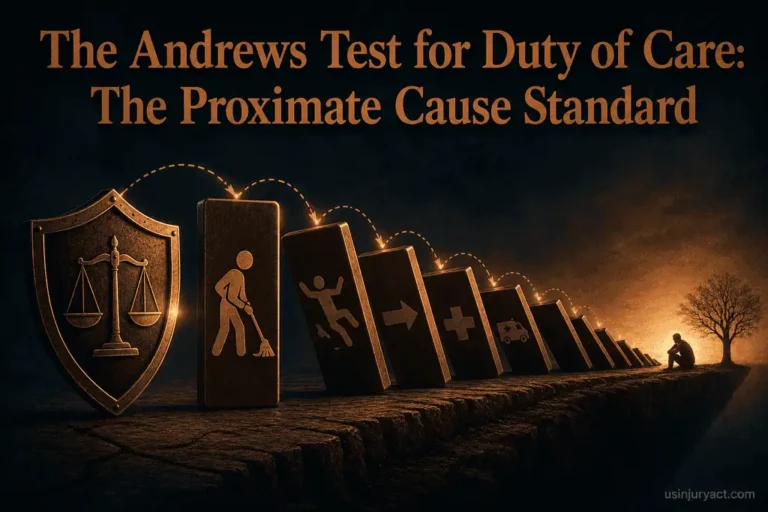
The Andrews test for duty of care holds that every person owes a duty of care to the world at large to refrain from acts that unreasonably threaten the safety of others. Under this test, the question of whether the defendant owed the plaintiff a duty is not where the negligence analysis focuses. Instead, the Andrews test places the critical analytical weight on proximate cause
Proximate cause in Andrew test determines whether the defendant’s wrongful act was sufficiently connected in time, space, and direct sequence to the plaintiff’s injury to hold the defendant legally responsible for it.
This test comes from Judge William S. Andrews’ famous dissent in Palsgraf v. Long Island Railroad Co., the same 1928 New York Court of Appeals case that produced the Cardozo majority opinion.
Where Cardozo asked “was this plaintiff foreseeable?” the Andrews dissent asked “was this act negligent, and was the plaintiff’s injury a proximate result of it?” These are profoundly different questions, and they produce different outcomes in close cases.
This post is written to give a thorough insight about the Andrew test including the legal philosophy behind it, how it differs from the Cardozo test, how courts that follow Andrews-style reasoning analyze proximate cause, as well as examples that illustrate where the Andrews approach changes outcomes
The Andrews Test: The Full Legal Argument Behind the Test
To apply the Andrews test with precision, you must understand the argument Judge William S. Andrews made in his Palsgraf dissent, because that argument contains the full philosophical architecture of the test.
Andrews opened his dissent with a broad proposition that negligence in the abstract does not exist. Negligence only exists in relation to someone who is actually harmed. But Andrews argued that this does not mean a defendant owes a duty only to foreseeable plaintiffs. He argued that a duty of care is owed generally, to society as a whole.
His exact reasoning, as captured in the documented record of the Palsgraf decision and widely cited in legal scholarship, was that every person owes to the world at large the duty of refraining from acts that may unreasonably threaten the safety of others.
Under this view, when the railroad employees negligently assisted the passenger in a way that caused a dangerous situation, they acted wrongfully, and the wrongful act created liability for its proximate consequences, including consequences to Mrs. Palsgraf.
For Andrews, duty was not the limiting principle, proximate cause was. So instead of asking “was the plaintiff foreseeable?” Andrews asked “was the plaintiff’s injury too remote in time or space or causal sequence from the wrongful act to fairly count as a proximate result of it?”
This is why the Andrews test is often described as a proximate cause test as opposed to a duty test, even though Andrews himself framed it in terms of the universality of duty.
The distinction matters practically because under Andrews, virtually everyone is a potential plaintiff once negligence is established; the limiting work is done by the proximate cause analysis, not by restricting who counts as a foreseeable plaintiff.
The “But For” Test Under Andrews: How Proximate Cause Is Analyzed
Andrews rejected the Cardozo foreseeability test and replaced it with a but-for causation tort law analysis grounded in proximity.
According to Andrews, the proper question is whether the injury would not have occurred but for the negligent act, and whether the injury was so connected in time, space, and directness of causation to the wrongful act that it is just and practical to hold the defendant responsible for it.
Andrews laid out several factors that courts using his approach should consider when determining proximate cause:
- The closeness in time between the wrongful act and the plaintiff’s injury. The more time that passes between the negligent act and the eventual harm, the weaker the proximate cause connection becomes.
- The directness of the causal chain. Intervening acts, especially intentional acts by third parties can break the causal chain between the defendant’s negligence and the plaintiff’s injury. A clean, direct causal sequence strengthens the proximate cause argument under Andrews.
- The distance in space between the negligent act and the point of injury. Harm that occurs very close to the locus of the negligent act is more proximate than harm that occurs at a great physical remove.
- The naturalness of the sequence. Was the chain of events that led from the defendant’s act to the plaintiff’s injury the kind of natural, uninterrupted sequence that a court can fairly describe as the defendant’s negligence “reaching” the plaintiff?
This multi-factor proximate cause analysis is fundamentally different from the Cardozo duty inquiry.
Under Cardozo, the question is resolved at the duty stage by a judge as a matter of law. Under Andrews, the proximate cause question is often a mixed question, judges set boundaries, but juries frequently make the ultimate determination of whether the causal chain was direct enough.
Andrews Versus Cardozo: The Practical Difference in Negligence Cases
The debate between these two approaches is not merely academic. It produces materially different outcomes in close cases, and litigants need to understand which framework their jurisdiction applies.
Under Cardozo, if a plaintiff cannot show they were within the foreseeable zone of danger at the time of the defendant’s negligence, the case ends at duty. No breach analysis. No causation analysis. No damages inquiry. The case is dismissed, typically by the judge, before a jury ever hears it.
Under Andrews, duty is broadly conceded as the defendant owed a duty to the world. The real litigation becomes about causation which means the plaintiff gets to proceed to argue to a jury that the causal chain between the defendant’s negligence and their injury was direct, unbroken, and proximate enough to support liability.
Juries in Andrews-style jurisdictions have more opportunity to find liability in unusual factual situations.
This means that plaintiffs in unexpected or attenuated causal situations fare better in Andrews-influenced jurisdictions. Their claims survive to the causation question meanwhile it would have been cut off at the duty gate under Cardozo test. For defendants, Cardozo-style foreseeability analysis is often more protective.
Plaintiff’s attorneys still focus on proximate cause in situations where their clients were injured in a somewhat surprising way precisely because the Andrews-style reasoning remains relevant in jurisdictions and in cases where the causal chain, though unusual, was direct and uninterrupted.
Real Examples Where the Andrews Test Produces Different Outcomes
Example 1: The Warehouse Fire and the Neighboring Business
A chemical company negligently stores flammable materials in violation of fire safety codes. A fire breaks out. The fire department responds and, in fighting the fire, must divert water resources that were otherwise available to the municipal system. As a result, a restaurant two blocks away experiences significantly reduced water pressure during its evening service and cannot operate its kitchen. The restaurant suffers a night’s worth of lost revenue.
Under the Cardozo test: the restaurant owner is probably not within the foreseeable zone of danger from the chemical company’s negligent storage. The foreseeable plaintiffs are people near the warehouse because those are the ones at risk of physical harm from the fire.
An economic ripple affecting a business two blocks away through a secondary effect on water pressure is likely outside Cardozo’s zone of foreseeable risk, and in that scenario, duty fails and the case dismissed.
Under the Andrews test: the chemical company acted negligently. The question is proximate cause. The causal chain runs: negligent storage → fire → fire department response → reduced water pressure → restaurant’s lost evening service. Is that chain direct enough?
Under Andrews, a jury might find that the chain, while somewhat attenuated, was unbroken and naturally sequential. A court applying Andrews reasoning would likely allow the case to proceed to the proximate cause determination rather than dismissing it at the duty stage.
This example illustrates the core difference.
- Cardozo uses foreseeability to limit duty and therefore cases.
- Andrews uses proximate cause to limit recovery, but only after allowing cases to proceed.
Example 2: The Runaway Vehicle and the Delayed Rescuer
A driver falls asleep at the wheel and negligently allows their vehicle to cross the center line. Another vehicle swerves to avoid the collision, loses control, and strikes a utility pole. The impact knocks out power to a traffic control system several blocks away. A pedestrian, crossing the street at a now-uncontrolled intersection (because the traffic signals are down), is struck by a vehicle that ran through what would have been a red light.
Under the Cardozo test: the pedestrian injured at the uncontrolled intersection may not be a foreseeable plaintiff of the original sleeping driver. The chain of events from the driver’s negligence to the swerving vehicle to the utility pole to the power outage to the traffic signal failure to the intersection accident is far removed from the zone of danger the sleeping driver created for drivers in the vicinity of the original incident.
Under the Andrews test: the question is whether this chain of events is sufficiently direct and proximate, that means there wereno intervening intentional acts. The sequence, while lengthy, was a continuous chain of physical causation flowing naturally from the original negligence.
An Andrews-influenced court might allow a jury to determine whether the causal chain was close enough in time and directness to hold the original driver responsible.
Example 3: The Workplace Negligence That Causes a Third-Party Injury
A manufacturing plant negligently maintains its equipment. An industrial component fails and is ejected from the machinery at high velocity, traveling through an open loading dock door and striking a delivery driver who was walking in the adjacent parking lot.
Under both Cardozo and Andrews, this case is relatively straightforward because the delivery driver is a foreseeable plaintiff under Cardozo since they are in the immediate physical vicinity of industrial equipment that could foreseeably malfunction and project objects outward, and they are an extremely proximate plaintiff under Andrews (the causal chain is direct and immediate, with no intervening acts and negligible distance between the negligent act and the harm).
Now let’s complicate the facts a little.
Suppose the delivery driver’s company upon learning of the driver’s hospitalization, sends a substitute driver. The substitute driver, rushing to complete the original driver’s route, causes a traffic accident. A person injured in that traffic accident sues the manufacturing plant.
Under Cardozo: the person injured in the traffic accident is not a foreseeable plaintiff of the manufacturing plant’s equipment maintenance failure. That person falls entirely outside the zone of risk created by the plant’s negligence.
Under Andrews: the court examines the causal chain. The manufacturing plant’s negligence caused the original driver’s injury. That injury caused the substitute driver deployment. The substitute driver’s rush caused a traffic accident. The causal chain involves multiple intermediate steps, including independent decisions by a third party which is the substitute driver, and spans considerable time and space.
Even under the Andrews test’s generous approach to duty, a court would likely find that the plaintiff injured in the traffic accident cannot establish proximate cause sufficiently direct to support liability against the manufacturing plant.
This example demonstrates an important point that the Andrews test is not unlimited. It still limits recovery through proximate cause. Intervening acts, especially independent decisions by third parties that contribute to the harm can break the Andrews causal chain just as they break the Cardozo foreseeability link.
Example 4: The Negligent Pharmacist and the Foreseeable Harm to a Third Party
A pharmacist negligently fills a prescription with a dosage that is twice the recommended level. The patient takes the medication and, because of the excessive dosage, experiences a sudden loss of consciousness while driving. The patient’s vehicle crosses into oncoming traffic, injuring another driver.
Under Cardozo: the other driver injured in the collision is a foreseeable plaintiff of the pharmacist’s negligence. When a pharmacist fills a prescription with an incorrect dosage for a patient who drives, the foreseeable class of harmed individuals includes other road users who may be endangered if the medication impairs the patient.
Courts in multiple jurisdictions extends the duty of pharmacists and prescribing physicians to third parties who are foreseeably endangered by medication errors.
Under Andrews: the causal chain is direct, brief, and involves no independent intervening acts. The pharmacist’s negligence → incorrect dosage → impairment → loss of consciousness → collision → injury to another driver. Proximate causation is readily established.
This example is notable because it produces the same result under both tests.
The Andrews test produces different outcomes only in cases where the Cardozo foreseeability analysis would cut off the plaintiff’s claim at the duty stage. Where both tests produce identical outcomes.
Example 5: The Negligent Contractor and the Subsequent Weather Event
A contractor negligently fails to properly seal a building envelope during construction. Six months after the building is completed and sold, a storm causes water infiltration through the improperly sealed areas. The water damage triggers mold growth. A tenant of the building develops serious respiratory illness as a result of the mold exposure.
Under Cardozo: is the tenant who did not exist as a party at the time of the contractor’s negligence a foreseeable plaintiff? Courts applying foreseeability-based duty analysis have generally found that contractors who negligently construct buildings owe a duty to foreseeable future occupants, because future tenants and purchasers are the obviously foreseeable class of people who will use and be affected by the building’s condition.
So Cardozo analysis supports duty here.
Under Andrews: the causal chain runs from the negligent construction through a weather event and several months of time to the eventual harm. The weather event is a natural occurrence, not an intervening human act. The chain is direct. The mold’s development from water infiltration is predictable. Proximate cause is established.
Again, both tests produce the same liability result in this scenario. The Andrews test becomes truly distinctive and determinative only when the Cardozo test would cut off a plaintiff as unforeseeable, but the causal chain was direct and unbroken enough that Andrews reasoning would allow recovery.
Where the Andrews Test Has Shaped Modern U.S. Law
Judge Andrews lost the Palsgraf case in a four-to-three decision. But his dissent has had a profound, lasting influence on American tort law, arguably rivaling the influence of the Cardozo majority in shaping how courts analyze negligence.
As Wikipedia’s legal analysis of the Palsgraf decision notes, many states have taken the approach championed by Andrews in dealing with proximate cause. The Andrews reasoning, that negligence creates a duty to all and that the limiting question is proximate cause, is reflected in how jury instructions on proximate cause are structured in numerous jurisdictions.
Scholars at the University of Florida Levin College of Law, writing in the Florida Law Review, have found that the debate between Cardozo and Andrews has resulted in significant divergence across states in who decides foreseeability and when. According to them, some states nominally following Cardozo but assigning foreseeability determinations to juries in ways that produce outcomes more consistent with Andrews-style reasoning.
The Restatement (Third) of Torts attempts to synthesize both approaches. It establishes categorical duties for drivers, property owners, professionals, and others as opposed to asking foreseeability at the duty stage in every individual case.
This effectively buries the Cardozo-Andrews dispute within a broader framework that uses proximate cause or “scope of liability” to limit recovery, which tracks Andrews’ analytical structure more closely than it might appear.
In proximate cause analysis generally, the “but for” causation test that Andrews championed appears in jury instructions across the country. The question “would the plaintiff’s injury have occurred but for the defendant’s negligence?” is now a standard part of negligence law in virtually every U.S. state, regardless of whether those states apply the Cardozo or Andrews framework to the duty element.
The Andrews Test and Intervening Causes
One of the most practically important applications of Andrews reasoning is in cases involving intervening causes. An intervening cause is a separate act or event that occurs between the defendant’s original negligence and the plaintiff’s injury and contributes independently to that injury.
Under Andrews’ proximate cause analysis, courts ask whether the intervening cause was foreseeable. If so, it does not break the causal chain. If an intervening cause was foreseeable and particularly if it was the very type of harm the defendant’s negligence created a risk of, then the defendant remains liable for the plaintiff’s injury through the Andrews chain of causation.
A foreseeable intervening cause (sometimes called a superseding cause when it breaks the chain) versus an unforeseeable one is a distinction that goes to the heart of Andrews’ framework.
This analysis is familiar in premises liability cases, product liability cases, and medical malpractice cases where the defendant argues that a third party’s conduct broke the causal chain.
Andrews in Practice: Why Plaintiff’s Attorneys Rely on It
In personal injury litigation, plaintiff’s attorneys in jurisdictions that apply Andrews reasoning have a significant strategic advantage in cases with unusual or indirect causal chains.
In place of fighting the battle at the duty stage where judges decide as a matter of law, they can get their case to a jury on the proximate cause question.
Juries tend to be more sympathetic to injured plaintiffs than judges applying abstract duty analysis. If the causal chain between a defendant’s negligence and a plaintiff’s injury can be shown to be direct, uninterrupted by independent causes, and reasonably close in time and space, a jury applying Andrews-style proximate cause reasoning may find liability even in situations where the harm was not normally foreseeable.
That’s why Andrews proximate cause test negligence arguments remain a critical tool in personal injury litigation – particularly in cases involving chain-reaction accidents, construction defects that manifest years later, medical failures that produce harms through indirect pathways, and product liability cases where the path from defect to injury involves multiple steps.
Key Takeaways on Andrew Duty and Proximate Cause Test
The Andrews test holds that duty is owed to the world at large and that the limiting principle in negligence cases is proximate cause, not foreseeability of the plaintiff. It was articulated in Judge Andrews’ famous dissent in Palsgraf v. Long Island Railroad Co. and has profoundly influenced how American courts analyze causation in negligence cases.
The test asks whether the defendant’s wrongful act was connected to the plaintiff’s injury by a direct, unbroken causal chain that is sufficiently close in time, space, and sequence to justify legal responsibility. It produces different outcomes from the Cardozo test primarily in cases where the plaintiff was not obviously foreseeable at the time of the negligent act but was nevertheless harmed through a direct and sequential chain of causation
Recommended: