Since you drive in Florida, you have likely heard conflicting information about exactly what your auto insurance must include. One of the most misunderstood questions in the state is that: is bodily injury coverage required in Florida?
The answer has a critical legal distinction that most drivers get wrong, and getting it wrong can have severe financial consequences.
Florida is one of a small number of states that does not universally require drivers to carry traditional bodily injury liability coverage. Instead, the state operates under a no fault insurance system.
But that system has specific gaps, proposed legislative changes are in motion in 2026, and what you do not know about Florida auto insurance law could leave you personally exposed after a serious accident.
In this post, we explain exactly what Florida law requires, what bodily injury liability coverage actually protects against, and why carrying it even when not mandatory is frequently the most financially sound decision a Florida driver can make.
Florida’s Auto Insurance Requirements in 2026
Florida’s auto insurance law is genuinely unique among U.S. states. The foundation of the current system is the Personal Injury Protection (PIP) requirement, which is the backbone of what is commonly called no fault insurance.
Under Florida Statute 627.736, all registered vehicle owners must carry a minimum of $10,000 in Personal Injury Protection coverage and $10,000 in Property Damage Liability (PDL).
What Personal Injury Protection Actually Covers
Personal Injury Protection coverage pays 80% of your reasonable medical bills and 60% of your lost wages up to the $10,000 policy limit, regardless of who caused the accident. You file the claim with your own insurer, not the at-fault driver’s company.
The goal of this system is to speed up payment and reduce litigation over minor accidents.
However, PIP coverage has serious limitations, it neither compensate you for pain and suffering nor fully replace lost income. Its $10,000 limit is exhausted quickly in any accident involving emergency care, hospitalization, or surgical procedures.
For anyone involved in a serious accident, PIP is a starting point, not a complete solution.
The Bodily Injury Liability Gap in Florida’s Insurance Law
Florida does not currently require most private passenger vehicle operators to carry Bodily Injury Liability (BIL) coverage.
This represents a meaningful gap in the state’s insurance requirements. Bodily injury liability coverage pays for injuries you cause to other people in an accident where you are at fault.
Without it, if you cause a collision that seriously injures another driver, pedestrian, or passenger, you may be personally liable for damages that greatly exceed your financial assets.
The Florida Department of Highway Safety and Motor Vehicles and the Florida Office of Insurance Regulation both confirm that BIL is optional for most private passenger vehicle operators under current law. However, important exceptions exist, and the legislative landscape is shifting.
Who Is Required to Carry Bodily Injury Coverage in Florida
While Florida does not impose a universal BIL requirement on all drivers, specific categories of drivers and vehicle classes must carry it by law.
Commercial Vehicle Operators and Fleet Drivers
Drivers operating commercial motor vehicles in Florida, including large trucks, delivery vehicles, and buses, are required under both federal and state regulations to carry bodily injury liability coverage.
The minimum limits required depend on the type of vehicle being operated and the nature of the cargo being transported.
Federal Motor Carrier Safety Administration regulations FMCSA establish these minimums independently of state law for interstate commerce.
Drivers With Prior Convictions, Judgments, or License Suspensions
Florida drivers who have been convicted of DUI, have had their license suspended following an accident, or have had a judgment entered against them arising from a prior crash may be required to carry bodily injury liability coverage as a condition of license reinstatement.
Florida Statute 324.023 outlines the enhanced financial responsibility requirements that apply in these circumstances.
Drivers required to file an SR-22 certificate of financial responsibility in Florida typically must carry bodily injury liability limits of at least $10,000 per person and $20,000 per accident as part of that filing requirement.
An SR-22 is not itself an insurance policy, it is a certificate that confirms you are carrying the legally required coverage.
Proposed Legislative Changes to BIL Requirements in 2026
Florida lawmakers have introduced bills in multiple recent legislative sessions that would make bodily injury coverage mandatory for all drivers. As of 2026, proposed reforms to Florida’s no fault insurance system have been active in the state legislature.
If enacted, these reforms would require Florida drivers to carry minimum BIL limits of $25,000 per person and $50,000 per accident, bringing Florida in line with the majority of U.S. states that already require bodily injury coverage.
Monitoring the Florida Legislature’s official website and updates from the Florida Department of Insurance is advisable for any driver who wants to stay current with these potential changes before they take effect.
Why Carrying Bodily Injury Coverage in Florida Is Critical Even If Not Currently Required
The fact that Florida law does not universally require BIL should not be confused with financial prudence. The risks of operating a vehicle in Florida without bodily injury coverage are substantial and well-documented.
Your Personal Financial Exposure Without Bodily Injury Liability
If you cause an accident that seriously injures another person and you carry no bodily injury liability coverage, the injured party can step outside the no fault system and sue you personally once their damages exceed what PIP provides, provided they meet Florida’s serious injury threshold.
In that situation, your personal assets are exposed.
Florida’s homestead exemption protects your primary residence in many situations, but it does not shelter bank accounts, vehicles, investment accounts, or business assets from a civil judgment.
Additionally, Florida’s dangerous instrumentality doctrine creates expanded liability for vehicle owners: even if someone else was driving your car with your permission and caused an injury, you as the owner may be personally liable for the resulting damages.
This doctrine makes Florida auto accident liability particularly significant for vehicle owners.
Florida’s Uninsured Driver Problem
Florida consistently ranks among the top states in the country for uninsured drivers on its roads. According to data tracked by the Insurance Research Council and the Insurance Information Institute, approximately 20% of Florida drivers operate without any insurance at all.
This creates a compelling argument for carrying Uninsured Motorist (UM) coverage alongside any bodily injury policy you purchase.
UM coverage protects you financially when you are struck by a driver who carries no insurance. In a state where one in five drivers on the road is uninsured, uninsured motorist coverage in Florida is not a luxury addition to your policy but a practical necessity.
How the Serious Injury Threshold Intersects With Bodily Injury Coverage
Florida’s no fault system limits your right to sue an at-fault driver for pain and suffering damages unless you meet the serious injury threshold established in Florida Statute 627.737.
Under that threshold, you can step outside the no fault system and pursue a tort claim if you have suffered a significant and permanent loss of an important bodily function, a permanent injury within a reasonable degree of medical probability, significant scarring or disfigurement, or death.
When the at-fault driver carries adequate bodily injury liability coverage, meeting this threshold matters enormously because it determines what damages you can pursue through that policy.
When the at-fault driver has no BIL coverage whatsoever, meeting the threshold matters far less in practical terms because there is no insurance coverage available to tap, regardless of what your claim is worth.
What Bodily Injury Coverage Limits Should Florida Drivers Actually Carry
If you decide to purchase bodily injury liability coverage in Florida, or if you are required to carry it, selecting appropriate limits is as important as having the coverage at all.
Minimum Limits vs. Recommended Limits for Florida Drivers
Standard bodily injury liability policies in Florida are structured in split limits: a per-person limit and a per-accident limit. A 10/20 policy covers $10,000 per injured person and $20,000 per accident total. A 25/50 policy covers $25,000 per person and $50,000 per accident.
Licensed insurance professionals and personal injury attorneys in Florida consistently advise carrying at least 100/300 coverage, meaning $100,000 per person and $300,000 per accident total.
Given Florida’s high cost of medical care, the density of its roadways, and the state’s active litigation environment, lower limits leave drivers unnecessarily exposed to personal liability that the policy should be covering.
Umbrella Policies as a Layer of Additional Protection
For Florida drivers who own significant assets, a personal umbrella insurance policy provides an additional liability protection layer beyond the limits of your underlying auto policy.
Umbrella policies typically begin at $1,000,000 in coverage and are considerably more affordable relative to the protection they provide.
For business owners, professionals, and anyone with meaningful personal assets, umbrella coverage is worth serious consideration.
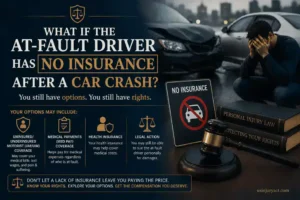
What Happens If You Are in a Serious Accident With an Uninsured Florida Driver
If you are struck by a driver who has no bodily injury liability coverage, your recovery options depend entirely on what coverages you have in place on your own policy.
This is where proper coverage planning pays off directly.
If you carry PIP, it will cover a portion of your immediate medical expenses up to your policy limit.
If you carry Uninsured Motorist coverage, it steps in to compensate you for pain and suffering, medical bills beyond PIP, and other damages the at-fault driver should have paid but cannot.
If you carry MedPay, it provides an additional layer of medical bill coverage regardless of fault.
If you carry none of these coverages and the at-fault driver has no BIL coverage and no significant assets, you may be left with a valid legal judgment that is nearly impossible to collect on in any practical timeframe.
Real-World Illustration of the Coverage Gap
Consider a driver who rear-ends another vehicle on Interstate 95 at high speed, causing serious cervical and lumbar spine injuries to the other driver.
The at-fault driver carries only PIP and PDL coverage as required by Florida law, with no bodily injury liability.
The injured driver’s PIP exhausts at $10,000. The injured driver clearly meets the serious injury threshold and can legally sue the at-fault driver personally, but the at-fault driver has no BIL coverage and owns no significant assets.
Collecting on that judgment becomes a years-long effort with uncertain results.
This scenario plays out regularly in Florida courts and illustrates precisely why bodily injury liability in Florida matters even in a no fault state.
Speaking to a Florida personal injury attorney immediately after any accident involving serious injuries is advisable.
An attorney can identify all potentially available insurance coverages, assess the at-fault driver’s financial position, and advise you on the most effective legal path available given the specific facts of your accident.
Key Takeaways
Bodily injury coverage is not universally required in Florida under current law, but that legal fact should not be misread as financial wisdom. Florida’s no fault system provides a baseline of protection through PIP, but leaves serious gaps that bodily injury liability insurance fills.
Driving in Florida without BIL coverage exposes you to personal liability that can be financially devastating. And if you are hit by one of Florida’s many uninsured drivers without UM coverage on your own policy, your options for meaningful recovery become severely limited.
The smart approach in 2026 is to carry robust coverage, review your policy limits annually, consult a licensed insurance professional, and speak with a Florida personal injury attorney if you have questions about what your current policy would actually cover in a serious accident.